
Originally delivered on May 13, 2026
Chairman Mendelson and members of the Committee, thank you for the opportunity to testify today. My name is Kate Coventry, and I am the Director of Legislative Strategy at the DC Fiscal Policy Institute (DCFPI). DCFPI is a non-profit organization that shapes racially-just tax, budget, and policy decisions by centering Black and brown communities in our research and analysis, community partnerships, and advocacy efforts to advance an antiracist, equitable future.
My verbal testimony focuses on the need to fund Permanent Supportive Housing (PSH) vouchers, expand the capacity at the Aston, increase the Personal Needs Allowance (PNA), and simplify the proof of residency process for residents experiencing homelessness. My written testimony also outlines DCFPI’s DC Health Care Alliance asks.
While the District has made strides in ending homelessness among individuals—particularly improving voucher implementation and launching a second bridge housing program—a complete lack of housing vouchers, lack of bridge housing beds, harsh income requirements for assisted living residents, and new roadblocks for obtaining identity documents (IDs) are undermining progress.
Black residents bear the brunt of these problems. Just over 76 percent of unaccompanied adults counted in the District 2025 Point in Time Count were Black.[1] This is the result of the enduring legacies of structural and individualized racism—such as racist zoning and residential segregation, redlining, restrictive covenants, and practices barring federal employment—that for years prohibited Black families from equitably accessing the housing and employment markets.[2]
The Department of Human Services Has Made Great Strides in Voucher Implementation, but Complete Lack of Resources Will Hinder Progress
The Department of Human Services (DHS) housed 1,322 households in fiscal year (FY) 2025, the highest number ever.[3] The agency’s pace in the first half of FY 2026 is even higher, with 782 households housed.[4] They also reduced the average length of time that individuals experience homelessness from 279 days in FY 2024 to 250 days in FY 2025.[5] DHS has achieved this progress by implementing housing-focused case management, deploying case management staff to shelters, and focusing on long stayers and the most difficult clients.[6]
But a lack of housing resources threatens this progress. The agency had just 336 new vouchers for families in FY 2026 but has paused matches after filling just 187 available vouchers (or 44 percent) because of agency budget pressures.[7] The FY 2026 budget included no new PSH vouchers for individuals. Additionally, many locally funded turnover PSH vouchers (i.e., those available due to churn) were effectively unavailable for new individuals in need because the District improperly budgeted them, requiring those savings to be folded into existing vouchers costs to account for growing rents. And it appears that there is no local funding dedicated to sustaining households who received federal Emergency Housing vouchers that are now expiring or who participate in the federal Shelter Plus Care program, which is also facing cuts.
The Committee should push for new PSH resources in the FY 2027 budget and ensure that all current vouchers are properly sustained so that current households do not lose their vouchers and new households can access them.
The Committee Should Urge DHS to Make It Easier for Unhoused Residents to Obtain Identification
A photo ID is required to access public benefits and to apply for most jobs and apartment leases—it is an essential tool that can help residents access basic needs, economic opportunities, and in some cases voting rights.[8],[9] In order to obtain a District ID, an individual needs to prove their identity and that they are a District resident. Residents experiencing homelessness often struggle to prove residency because they do not have a lease or bill that confirms their address, which is part of the standard process that the Department of Motor Vehicles uses to issue licenses and IDs. Residents who are unhoused can instead obtain a social service proof of residency form in which a homeless services provider confirms their homelessness and their DC residency, thereby allowing them to begin to rebuild and access housing and economic supports.
Prior to this year, individuals could obtain this form from more than 30 homeless services agencies, often allowing an individual to get the form from their existing service provider.[10] The District has now reduced the number to 11 locations: three adult day centers, four youth drop-in centers, and four homeless outreach providers, meaning most individuals will have to make a special trip to an agency with whom they do not have a relationship.[11] Two of the three adult day centers are located in men’s shelters, and some women experiencing homelessness have reported that they do not feel comfortable going to these locations.[12] The outreach providers are often on the street serving their own clients in the field and are not able to spend time at the agency’s service locations to serve other clients.[13] Individuals have reported that despite making trips to multiple providers, they have been unable to secure the form because the providers had run out of forms.[14]
Advocates have met with DHS and the DMV to discuss these challenges. DHS committed to working with domestic violence and LGBTQ+ service providers to create safe access points for these populations. DHS also reported that they will make sure each social service agency has a sufficient supply. These are both positive steps. But as part of refining this process, DHS should hold surveys, focus groups, or interviews with clients experiencing homelessness to gather feedback on how the new process is working and, if needed, ways to improve the process—and this Committee should hold them accountable to these commitments
The Council Should Interrogate Whether Expanding Capacity at the Aston or Opening New Bridge Housing is Timelier and More Cost Effective
The District, like many other jurisdictions, has primarily provided congregate shelter for individuals experiencing homelessness. While the District has recently built new shelters and rehabilitated existing shelters, many of these congregate shelters are in older, large buildings that have been repurposed as shelter. Residents generally sleep on bunk beds. The spaces are often loud, dirty, and chaotic. There is very little privacy. Many residents who are unhoused report in Interagency Council on Homelessness meetings that they do not feel safe in shelter. These conditions lead many individuals to sleep outside rather than going into shelter.
Bridge Housing addresses these issues as well as a longstanding issue highlighted in Homeward DC 2.0, the District’s Strategic Plan to End Homelessness: the need for co-ed shelter capacity to ensure that mixed gender adult households—such as adult siblings, a parent and adult child, and domestic partners—can access shelter together.[15] Bridge housing also serves clients with self-managed but chronic conditions that benefit from privacy and space. And finally, bridge housing targets those who have been avoiding congregate shelters and are living outside.
The Aston is a type of Bridge Housing that can accommodate 190 individuals, but public officials capped its current capacity at 100 because of demands from and an agreement with the building’s neighbors rather than allowing the site to serve more people who are unhoused. A second bridge site, 25 E, is currently enrolling clients in waves, and DHS anticipates that this site will be at its full capacity of 190 slots in June.[16] The proposed FY 2026 supplemental budget includes $25 million in capital funds to acquire new Bridge Housing, and the FY 2027 budget includes $3.4 million for operating costs.[17],[18]DHS reports they plan to acquire a building by the end of calendar year 2026, but the move-in timeline “will be dependent on the timeline of the required renovations.”[19] The Aston took more than two years to open after the Council approved acquisition of the property, and 25 E took nearly two years. It is likely the new site will require a similar timeline.
Expanding capacity at the Aston can happen quickly once lawmakers approve the funding. This will also help address the ongoing shortages of shelter beds for individuals during non-hypothermic weather when individuals do not have the right to shelter. If DC fails to fund an adequate supply of beds, some individuals will have no choice but to sleep outside during a time when the District and the National Park Service are regularly clearing encampments. Advocates are also worried that the president may pressure the District to have no visible homelessness during the America 250 celebrations.
I also urge the Committee to examine whether it is fiscally sound to continue allowing the Aston to operate at less-than-full capacity. Part of that effort should be interrogating why the Aston’s FY 2027 per-person monthly cost of $2,972 is so much higher than 25 E Street’s cost of $2,125, and whether its reduced capacity is a contributing factor to this price difference.[20] If so, the District should expand the Aston and consider a third bridge site that can accommodate more individuals and bring the per person cost down.
The Council Should Restore Funding to the Personal Needs Allowance
Some unhoused DC residents are rejecting assisted living because of harsh income rules that leave them unable to afford basic items and compromise their quality of life. DC residents who use Medicaid coverage to pay for assisted living must contribute all their monthly income towards the cost of this care, except for a PNA of $138.[21] This PNA is intended to cover personal expenses not provided by the facility, such as cell phone bills, toiletries, and prescription copays. But the amount is so inadequate that it forces these assisted living residents to go without necessities and leads some individuals to reject assisted living altogether.[22] Black DC residents, who are insured through Medicaid at much higher rates and more likely to experience chronic homelessness than residents of other races because of systemic racism, are disproportionately at risk of being harmed by the PNA policy.[23]
Some individuals experiencing homelessness or receiving housing and services through the District’s PSH programs, especially seniors, have needs that providers are not meeting, such as help with bathing and dressing.[24] Assisted living facilities are an alternative option to get housing and deeper levels of care. But many facilities will not accept clients who have experienced homelessness and/or have behavioral health conditions.[25] Some facilities have regulations that explicitly exclude individuals with substance use disorders or mental health conditions. Others may deny access because of bias or unwillingness to prescribe or manage medications for behavioral health issues and substance use disorders.[26]
To address this need, the District helped fund the District’s first assisted living/PSH facility, Abrams Hall, for people experiencing chronic homelessness or in need of more services than their homelessness program can provide. The program offers all the services provided by traditional assisted living programs including meals, medication management, laundry, and house cleaning. But it also provides a PSH case manager to help connect residents with resources and trouble shoot problems that could lead to eviction.
When it opened in September 2022, Abrams Hall could only fill 22 of its 54 units with individuals who had experienced homelessness.[27] By May of 2025, only nine of the 54 units were occupied by these individuals.[28] Due to low participation, DC made the remaining units available to seniors with low incomes who have not experienced homelessness.
PSH residents reported they would stay in their current placement and unhoused residents reported they would wait for a PSH placement since PSH only requires residents to contribute 30 percent of their income towards rent and utilities.[29] For example, a PSH resident may receive Supplemental Security Income, which is a benefit for those with limited income and assets who are also over 65 or have a qualifying disability.[30] The maximum monthly benefit is $994.[31] An individual enrolled in PSH would pay $298 in rent and retain $696 for their monthly expenses—or about five times more than what they could maintain under the PNA at Abrams Hall.
Residents who stay in PSH rather than moving into assisted living are likely to face difficulties moving forward, as PSH does not offer the intensity and types of services provided by assisted living. For those who are unhoused, they may wait years for a PSH voucher. There are no PSH vouchers for individuals in the FY 2026 budget. By increasing the PNA, the Council will help individuals end their homelessness more quickly and receive the services they need.
Recognizing the harm of the PNA policy, the DC Council added a provision in the FY 2026 budget that directed $500,000 of recurring FY 2025 revenue growth to increase the PNA to $300 as long as the additional revenues exceed actual expenditures, as estimated by the Chief Financial Officer (CFO).[32] In December, the CFO certified the additional revenue was available, but the mayor eliminated this funding in her proposed FY 2026 supplemental budget.[33], [34],[35] DCFPI urges the Council to restore this funding to the supplemental budget and/or to the FY 2027 budget.
The Health Care Alliance is a Vital Program That Lawmakers Should Protect
Health insurance plays a pivotal role in improving health outcomes and ensuring broader quality of life. Despite that fact and DC’s longtime commitment to near universal health coverage in the District, thousands fewer immigrants in DC have access to affordable health insurance under drastic changes that District lawmakers approved to the Health Care Alliance program (the Alliance) that began to take effect in October 2025.
Nearly 25 years ago, DC leaders created the Alliance—a program that served about 23,000 residents per month in FY 2024—with the belief that everyone should have access to healthcare, regardless of immigration or economic status, and that widespread coverage is good for residents’ health and less costly than the alternative.[36] But facing a tight FY 2026 budget, District lawmakers made several cuts to the program, including:
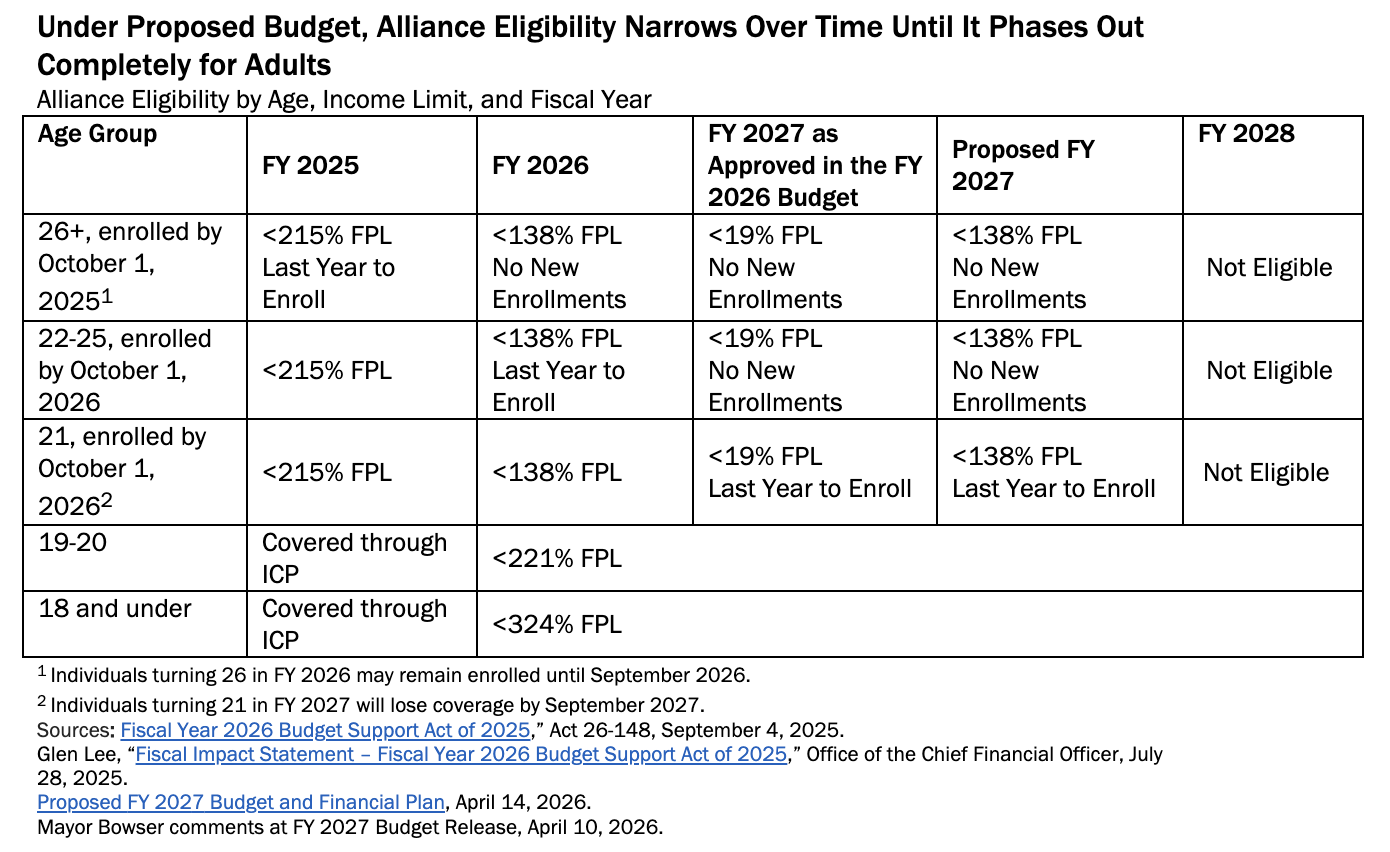
- halting new enrollment for adults over age 26 starting in October 2026 and ending eligibility entirely for all adults over 20 in October 2027;
- reducing covered benefits; and,
- reducing the income eligibility threshold for adults over the age of 20 from 215 percent of the federal poverty line (FPL), $57,300 for a family of three, in FY 2025 to 138 percent of FPL in FY 2026, $37,702.[37],[38]
Approximately 2,200 individuals lost coverage on October 1st because of the income eligibility change alone.[39]
Newly ineligible residents will struggle to pay for healthcare, may avoid or delay needed care and even die from diseases that could have been successfully treated if the individual received timely care.[40] The Alliance provides health coverage to residents with low incomes who are not eligible for Medicaid—primarily immigrants. This eligibility change comes as the federal government escalates deportations and targets immigrants for other benefits cuts. Congress has recently excluded more lawfully present immigrants from Medicaid, and federal agents are rounding up immigrants, including those with legal statuses.[41],[42]
While the Budget Is Somewhat Better Than Expected, Changes Vastly Reduce Alliance’s Reach
The proposed budget keeps harmful cuts made in the FY 2026 budget in place, and it excludes the planned reduction to the income eligibility threshold and reduces the age threshold in FY 2027. The proposed budget eliminates the program for adults in FY 2028 as planned.
The mayor’s proposed budget retains the current FY 2026 income threshold for eligibility rather than decreasing it as planned. For adults over age 20, lawmakers decreased the income threshold from 215 percent to 138 percent of FPL in FY 2026 (Table 1). They also approved a planned decrease to the income threshold to 19 percent of FPL in FY 2027 before eliminating the program for this group in FY 2028. The mayor’s proposed FY 2027 budget keeps the 138 percent threshold but maintains the plan to eliminate the program for this group in FY 2028.
The proposed budget retains the enrollment moratorium but lowers the age threshold from 26 to 21. Beginning in October 2025, or FY 2026, individuals over the age of 26 were no longer allowed to newly enroll in the program. Under the mayor’s proposal, enrollment would be further restricted in October 2026, when only individuals under age 21 will be allowed to newly enroll. Existing enrollees have a 90-day grace period to renew their coverage, or the Department of Health Care Finance will drop them from the program.
The proposed budget restores vision and dental but does not restore other critical benefits. The Council-approved FY 2026 budget limited the Alliance benefit package, no longer covering care such as vision, dental, non-emergency transportation, podiatry, and home healthcare services. Recognizing the harm of these cuts, the Council added a provision in the FY 2026 budget that directed a portion of FY 2025 revenue growth to restore the benefit package for FY 2026 as long as the additional revenues exceed actual expenditures, as estimated by the CFO.[43] In December, the CFO certified the additional revenue was available, but the mayor didn’t include it in her proposed FY 2026 supplemental budget.[44],[45] The proposed FY 2027 budget reinstates vision and dental benefits but not the other benefits.
Table 1.
Alliance Cuts Will Primarily Harm Hispanic and Black Residents
Alliance changes will primarily hurt DC’s Hispanic and Black residents, including those who are documented and undocumented.[46] In FY 2020, 50 percent of Alliance recipients were Hispanic, 20 percent were Black, and just over 2 percent of recipients were white (Figure 1).[47]
Figure 1 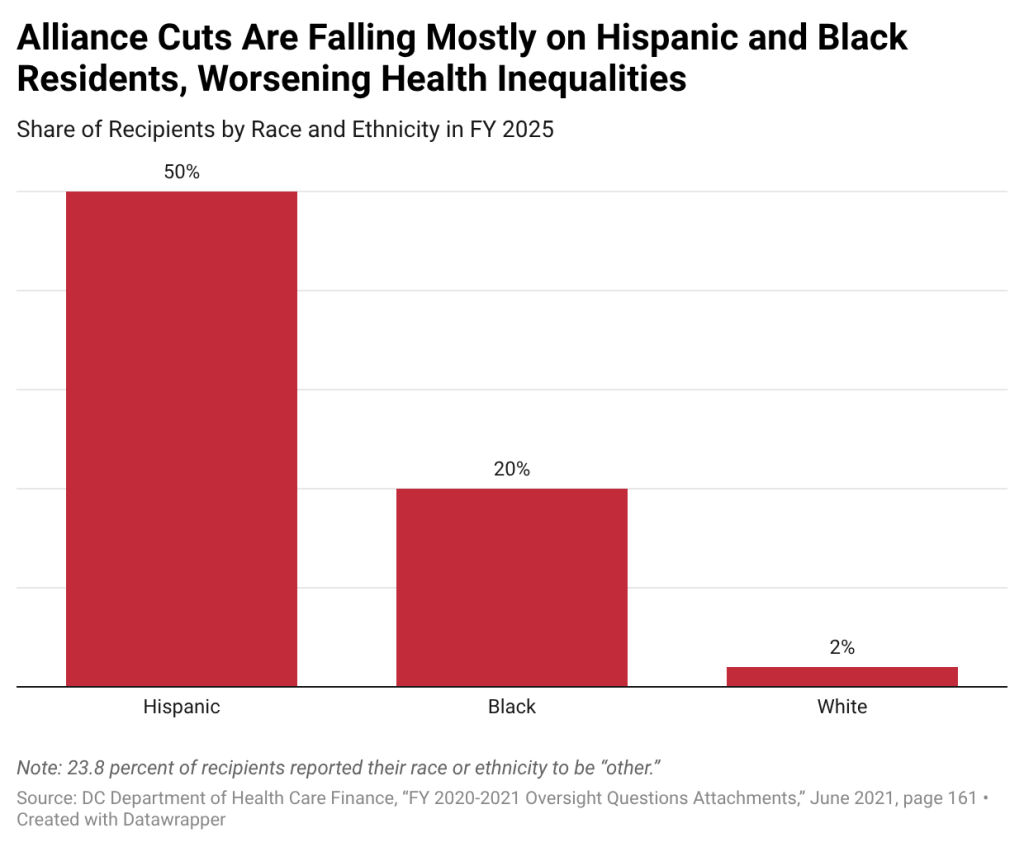
The current federal policy shift on immigration and local changes to the Alliance are part of a long, racist history of restrictions on immigrant access to public benefits. Prior to 1965, immigrants to the United States primarily came from Northern and European countries and federal law did not exclude immigrants from public benefit programs.[48] When federal lawmakers created Medicaid in 1965, they required states to cover everyone in all mandatory coverage groups regardless of their citizenship or immigration status.[49] Then the immigration system also changed in 1965, leading to greater numbers of immigrants coming from Asia and Latin America.[50]
Starting in the early 1970s, Congress and some states began restricting immigrants from public benefit programs due to xenophobia and racism. Political leaders and the press promoted disproven stereotypes to justify exclusion. They used similar stereotypes to make it harder for Black Americans to access benefits as well.[51]
The Nixon administration barred undocumented immigrants from Medicaid, but a federal court overturned that policy.[52] In response in 1986, Congress passed a law barring federal reimbursement of Medicaid services to states for undocumented residents, except for life-threatening medical emergencies.[53] As a result of racist stereotypes and a desire to cut spending on programs that benefited people with low incomes, federal lawmakers excluded many documented immigrants and all undocumented immigrants from Medicaid. DC created the Alliance program in 2001 to address this gap in the safety net for local immigrants.[54]
Alliance Cuts Are Harming Immigrant Residents Who Are Particularly in Need with Ripple Effects for All of DC
Immigrants, even those with documented status, have limited health coverage options and thus are in particular need of programs like the Alliance. Medicaid has long excluded many immigrants and Congress adopted new Medicaid and Affordable Care Act marketplace prohibitions in 2025 that exclude even more immigrants.[55] In addition, noncitizen immigrants regardless of status are more likely to be employed in jobs that have lower wages and lack employer-sponsored health insurance.[56] They are also more likely to work in sectors with higher adverse health risks.[57], [58] Taking away this vital safety net will likely make it harder for some immigrants to stay healthy and remain on the job, harming them and DC’s economy. Other ripple effects of the mayor and DC Council slashing of Alliance include:
Additional Pressure on Federally Qualified Health Centers with Fewer Resources
Federally Qualified Health Centers (FQHCs) are “safety net” providers, including community health centers and programs serving migrants and people experiencing homelessness.[59] Their main purpose is to improve primary care services in underserved urban and rural communities.[60] FQHCs are obligated to serve patients even if they cannot pay, but they are limited in the services they can provide.[61] They don’t provide cancer treatment, dialysis, or durable medical equipment such as wheelchairs, for example.[62]
While they will care for patients regardless of their ability to pay, FQHCs will likely face a critical funding gap due to the increase in uninsured patients following Alliance cuts. The DC Primary Care Association, the membership organization of local health centers, reports that FQHCs are projected to lose $12.4 million annually when the Alliance is eliminated for adults in FY 2028.[63] FQHC directors report that they will not be able to absorb this loss and that they will have to lay off staff. They fear remaining staff will burn out as a result, and the reduced capacity will force patients to rely on expensive emergency room visits that are not designed for helping patients manage diseases like hypertension and diabetes.
Increased Reliance on Costly Emergency Room Visits
Individuals without insurance often skip preventive care and postpone routine care until they have an emergency.[64], [65] By law, emergency rooms must provide patients with life-saving care even if they lack health insurance. But hospitals can charge these patients higher prices than insured patients.[66] Insurance companies negotiate with hospitals for reduced prices for their clients, but the uninsured do not have the same negotiating opportunities and can be charged thousands of dollars more than insurance companies pay. [67], [68]
The Centers for Medicare & Medicaid report that unnecessary emergency room visits should be avoided as “they are costly and consume resources that other individuals with more acute needs may need.”[69] DC emergency rooms already have the longest wait times in the country, averaging 5 hours and 29 minutes, and now many former Alliance patients will seek care in the emergency room, making this wait time increase.[70]
Increased Medical Debt for Residents with Low Incomes
Often hospitals bill uninsured patients and use harmful debt collection practices. And, although District law actually requires hospitals to provide uncompensated care for uninsured people with low incomes (at no less than 3 percent of their operating expenses), they are allowed to count bad debt toward that requirement, which they can later write-off.[71] Because of that loophole, private, nonprofit hospitals in the District spent just 0.80 percent of their operating expenses on free or reduced price care in 2021, for example.[72] Additionally, the District does not require hospitals to inform patients of the availability of financial assistance.[73]
Medical debt harms an individual’s ability to obtain a job, housing, and other lines of credit.[74] The American Cancer Society reports that it is “associated with more days of poor physical and mental health, more years of life lost and higher mortality rates for all-cause and leading causes of death.”[75] Medical debt is also the leading cause of bankruptcy, which harms the broader economy. Fear of medical debt may lead some residents to delay or forgo care. National polling has found that 28 percent of respondents delayed or did not receive health care due to cost.[76]
Loss of Coverage for Pregnant People Just Two Months After Delivery
The District will provide pregnancy-related care through the federal Children’s Health Insurance Program (CHIP), which allows states to cover parents regardless of immigration status as part of covering low-income citizen children from conception to birth. CHIP covers prenatal care, labor, and delivery, but only offers two months of postpartum services. This is inadequate because pregnancy-related complications can develop up to a year after childbearing.[77] Nationally, nearly 12 percent of pregnancy-related deaths occur between 43 to 365 days postpartum.[78] For this reason, the Alliance and Medicaid both offer 12 months of postpartum care. However, as eligibility for the Alliance shrinks, people also ineligible for Medicaid will be left with insufficient postpartum services through CHIP.
The DC Council Should Reverse Harmful Alliance Cuts
The Council should remove the enrollment cap and reinstate the original income threshold for the Alliance, 215 percent of FPL. The Council should also restore the benefit package in the FY 2026 supplemental budget to allow enrollees to access the care they need.
Finally, the Alliance has never covered outpatient mental health services, but until recently individuals with severe mental illness were able to receive assessments, outpatient therapy, medication, or specialty in-home services through the Department of Behavioral Health (DBH). Despite the Council Committee on Health committing to working with the Department of Health Care Finance and DBH to maintain these services until the Alliance sunsets for adults over age 20 completely, the District took these services away from residents who now surpass the income eligibility limit.[79],[80] DCFPI urges the Council to reverse these cuts, especially as agency leaders failed to discuss them during the FY 2026 budget season when the Council could have acted.
Thank you for the opportunity to testify and I am happy to answer any questions.