
Testimony delivered on March 4, 2026
Chairperson Henderson, members of the committee, thank you for the opportunity to testify. My name is Anne Gunderson, and I am a Senior Policy Analyst at the DC Fiscal Policy Institute (DCFPI) and a member of the Under 3 DC Coalition (U3DC). DCFPI is a non-profit organization that shapes racially-just tax, budget, and policy decisions by centering Black and brown communities in our research and analysis, community partnerships, and advocacy efforts to advance an antiracist, equitable future.
My testimony focuses on the progress the DC Health Benefit Exchange (DCHBX) has made on the HealthCare4ChildCare (HC4CC), which is expanding its reach across DC and in wards East of the Anacostia River, and progress on the new Healthy DC Plan. My testimony also underscores how devastating losing the Pay Equity Fund (PEF) and Medicaid expansion would be to workers’ and residents’ wellbeing and health.
HealthCare4ChildCare is Providing Affordable Health Care to Child Care Workers in all Eight Wards
Health insurance is a critical component of compensation for early educators, as envisioned in the Birth-to-Three for All DC Law. HC4CC makes free or low-cost health care coverage available to child care workers who live in the District and non-District child care workers whose employers purchase coverage through DCHBX. To date, more than 3,300 child care employees and their families have benefited from HC4CC, many of whom are receiving employment-based health care for the first time.[1] Many educators have testified before the Council about how life-changing this program has been for them, and every dollar DC invests in HC4CC nets over a dollar in premium value, making it a beneficial program for the entire District.[2]
DCHBX instituted a waitlist for HC4CC coverage for new child care facilities on January 1, 2025, due to insufficient funding. There are no facilities currently on the waiting list but there are 53 facilities that are eligible but not currently enrolled in HC4CC.[3] HC4CC covers 350 more individuals today than it did one year ago, reaching 2,317 people.[4] Over the past year, DCHBX has also made progress in expanding coverage in Wards 7 and 8, which had the smallest percentage of facilities enrolled in HC4CC group coverage of all wards this time last year.[5] The number of people covered by facilities located in Ward 7 nearly doubled—from 57 people to 104—and the number of people covered in Ward 8 increased from 219 in January 2025 to 289 in February 2026.[6] Ward 7 continues to have the smallest percentage of eligible facilities enrolled, and the waitlist for HC4CC means delaying progress on further expansion of coverage there and across the District.[7]
To fulfill the promise of “parity” made in the Birth-to-Three for All DC Act, the PEF should, at minimum, include a comparable salary scale to DCPS teachers and health care benefits.[8] Higher pay and affordable health care work hand in hand to fairly compensate early educators, and the health care program helps workers avoid costly benefit cliffs once their pay pushes them above income eligibility for Medicaid. As the federal and local health care safety net shrinks rapidly, protecting HC4CC will be extremely important for protecting the early education workforce’s economic security and health. For example, federal changes to health care policy have created restrictions on who is eligible for coverage and made it more expensive to deliver coverage, including in the marketplace.[9] If lawmakers were to eliminate HC4CC in the budget, many educators receiving higher pay under PEF would not qualify for Medicaid, some may not qualify for the Healthy DC Plan, and others could be priced out of the marketplace given the loss of the enhanced premium tax credits (EPTCs).
DCFPI is grateful that DCHBX continues to work diligently to ensure that educators living in DC who are at risk of losing Medicaid coverage due earning higher salaries are pulled into HC4CC for individual coverage. DCHBX’s commitment to creating a well-designed health care program is likely one reason why the PEF has been so effective at attracting more educators to early childhood classrooms, increasing the retention of qualified educators, and expanding access to high-quality, affordable care to District families.[10] Their deep commitment to provide coverage to as many facilities, educators, and their families as possible has allowed this program to thrive. DCHBX has also thoughtfully engaged the community and facilities via outreach events and an advisory council, engaged the U3DC Coalition in policy decisions, and kept us updated on critical administrative changes, pulling us in as partners to expand the reach and efficacy of HC4CC.
The limited budget for HC4CC and the constant threats of defunding the PEF entirely are now stymieing progress towards the ultimate goal of early educators having access to health care when they choose to work in any District child care facility. We look forward to continuing partnership with DCHBX to ensure that they have the resources needed to continue this important work.
DCHBX Should Be Commended for Its Efforts to Standup The Healthy DC Plan
DCFPI applauds DCHBX for thoughtfully and swiftly establishing the new Healthy DC Plan, which is providing free or low-cost health care coverage to a large portion of the adults losing Medicaid due to fiscal year (FY) 2026 budget cuts. In a handful of months, HBX created an Advisory Council—on which DCFPI and other stakeholders serve—to help design the new plan from scratch, secure federal approval to move forward, stand up new well-designed IT systems, conduct community outreach, and coordinate with other DC agencies to ensure continuity of care and a seamless transition for the many thousands of adults shifting into the Healthy DC Plan. DCFPI particularly commends HBX for including a trigger in the Healthy DC Plan Blueprint that would expand coverage of dental and vision services if the federal government renews the EPTCs (i.e., reinvesting those savings back into the Healthy DC Plan), although that extension is unlikely to occur.[11]
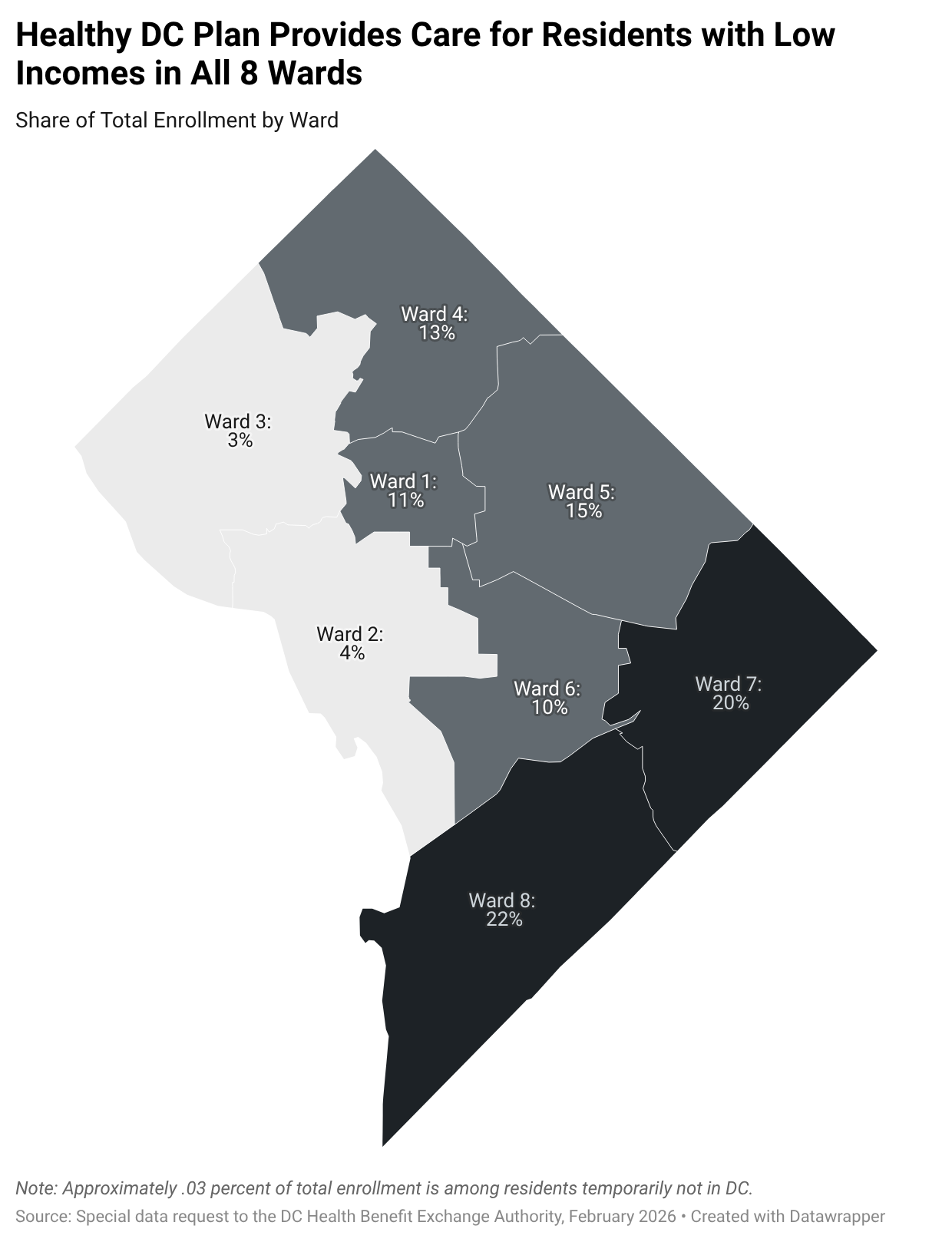
Residents in Wards 7 and 8 have the highest take-up rates of the Healthy DC Plan so far, with 42 percent of total enrollment occurring there and nearly half of enrollment in Wards 1, 4, 5 and 6 (Figure 1). This is not surprising given Wards 7 and 8 have the lowest average incomes in the District, due in large part to a legacy of anti-Black racism and discrimination. Unsurprisingly, there is low enrollment in Wards 2 and 3 where wealthier and white residents are likelier to reside.
Figure 1.
HBX has worked well within the funding constraints set by the mayor and DC Council. However, DC lawmakers should be concerned that the FY 2026 budget they adopted is resulting in less affordable and expansive health care coverage. This is true for the group of residents shifting into the Healthy DC Plan (which lacks funding sufficient to match all Medicaid benefits, such as rehabilitative behavioral health services) as well as for the population the District is sending into the marketplace to find commercial coverage on their own, which is considerably more expensive and is expected to skyrocket even higher in the absence of EPTCs.[12] Lawmakers should use their oversight powers to track the number of residents losing Medicaid, document and interrogate the impact of offering fewer benefits in the Healthy DC Plan due to insufficient funding, and document how many people in this shift end up with no coverage in 2026 (even with all of HBX’s thoughtful planning).
One outstanding concern for adults covered by the Healthy DC Plan is that the Medicaid fair hearing and due process rights do not attach to basic health plans and marketplace coverage, which could harm retention of benefits for some adults.[13] DC lawmakers and HBX need a transparent accountability process for making sure that Healthy DC Plan enrollees are actually getting access to the care to which they’re entitled. The Committee should make sure that DCHBX has the authority to review access to care issues—such as denials of claims and prior authorizations—and end participation with carriers that inappropriately deny access to care. Nationwide, insurers of qualified health plans sold on the marketplace deny about 20 percent of all claims, reducing access to health care.[14] DCHBX should be able to monitor denied claims and how carriers are applying prior authorization rules, and they could include this in their annual contracts, if permitted.
Broader Cuts to Health Care Programs Are Very Concerning
DCFPI is concerned about the recent federal policy change that would limit federal funding for the Healthy DC Plan’s coverage of many lawful permanent residents with incomes below 100 percent of the federal poverty level (FPL), but not for those with incomes between 100 percent of FPL and 200 percent of FPL until calendar year 2027. In December, the Department of Health Care Finance testified that they expect flexibility from the federal government to keep this group of residents with incomes below 100 percent of FPL enrolled in the DC Health Care Alliance program, and DCFPI is looking forward to learning more about that approach and plans to limit harm for them in the coming years.[15]
DCFPI is also gravely concerned that DC’s financial plan eliminates Medicaid expansion for working-age adults without a disability and without children in the home in FY 2029, harming 93,000 residents living with poverty-level and low incomes. The mayor estimates this would save $77.3 million in local funds but that ignores the significant level of federal funding DC receives for expansion coverage, which has a federal matching rate of 90 percent.[16] In FY 2024, DC received $645 million in federal dollars for the expansion population and spent approximately $71.4 million locally.[17] The choice to eliminate Medicaid coverage for this group of vulnerable adults doesn’t make fiscal sense, would blow a huge hole in DC’s health care safety net, reverse some of the District’s large reductions in its uninsured rate, and backtrack on efforts to advance racial equity and progress.
Thank you, Councilmember Henderson, for your steadfast support of the Pay Equity Fund and HealthCare4ChildCare and thank you for the opportunity to testify. I am happy to take questions.